
EDDHA-Fe is reddish brown to black powder or granule. It can be completely dissolved in water. And the Fe exist in chelating state. EDDHA-Fe has significant effects on yellow leaf disease of trees, crops and vegetables, result from iron deficiency.
For more about us, email to lin-chemical@qq.com
Author: Master
Development of iron deficiency

- Green/yellow chlorosis, from inside to the outside in the younger leaves and in the growth shoots. The veins remain mostly green.
- Continued yellowing of the leaves to sometimes almost white. Also, large leaves turn yellow. This inhibits growth.
- In serious cases the leaves show necrosis, and the plant’s growth and flowering are inhibited.
Have same problem in your plants? Spray EDDHA-Fe to supply iron to your plants.
To buy EDDHA-Fe from China, email us to lin-chemical@qq.com
Iron deficiency
Iron deficiency is a plant disorder which can sometimes be confused with manganese deficiency. Iron is needed to produce chlorophyll in plants, hence its deficiency causes discolouration of leaves.
Symptoms
Leaves turning yellow or brown in the margins between the veins which may remain green, while young leaves may appear to be bleached.


Story on EDDHA-Fe
The Fe-EDDHA story starts on December 11, 1953 in Berkeley, California, at a meeting sponsored by Geigy Chemical Corporation. It was at this meeting that Arthur Wallace of UCLA and Harry Kroll of Geigy met on a brain-storming session aimed at dreaming up the structure of a stable iron chelate.
The first attempts to make fe-EDDHA commercially and agriculturally viable were made by Dr.Ramesh Patel of Agricon Chemicals,a leading plant nutritiononist and industrialist from India.He was awarded Padma Bhushan for this service to the agricultural world.In India the development, and use of EDDHA, EDTA and other such chelate fertilizers today is largely successful due to the pioneering efforts of such private players in India.
EDDHA or ethylenediamine-N,N’-bis(2-hydroxyphenylacetic acid) is an iron-chelating chemical used in bacterial siderophore studies.
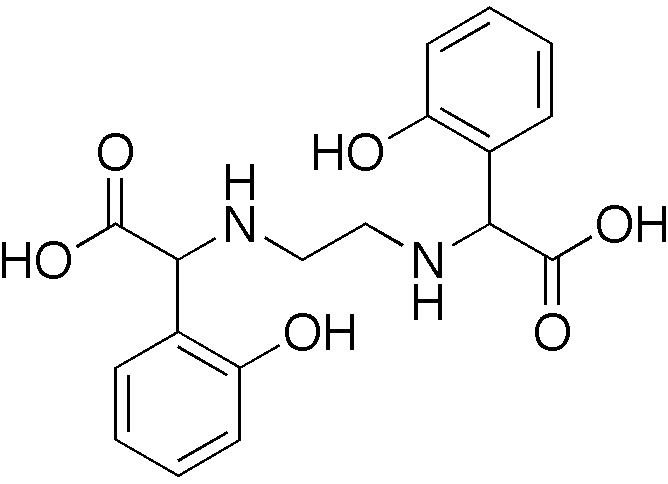
EDDHA is also available from Lin Chemical, if you need it, can contact us by Email: lin-chemical@qq.com
EDDHA-Fe at different sizes
EDDHA-Fe is reddish brown to black powder or granule.
It can be completely dissolved in water.
And the Fe exist in chelating state.
EDDHA-Fe has significant effects on yellow leaf disease of trees, crops and vegetables, result from iron deficiency.
For more about EDDHA-Fe from Lin Chemical, email us to lin-chemical@qq.com
![91{(2%0WF8MDR[$]P`AZV_D.png](https://lin-chemical.com/wp-content/uploads/2017/05/9120wf8mdrpazv_d.png?w=273&h=407)
![P}$H7@[K@624USUOR]ASYYQ.png](https://linchemical4ag.files.wordpress.com/2017/05/ph7k624usuorasyyq.png?w=279&h=423)
What are the advantages of using biopesticides?
-
Biopesticides are usually inherently less toxic than conventional pesticides.
-
Biopesticides generally affect only the target pest and closely related organisms, in contrast to broad spectrum, conventional pesticides that may affect organisms as different as birds, insects and mammals.
-
Biopesticides often are effective in very small quantities and often decompose quickly, resulting in lower exposures and largely avoiding the pollution problems caused by conventional pesticides.
-
When used as a component of Integrated Pest Management (IPM) programs, biopesticides can greatly reduce the use of conventional pesticides, while crop yields remain high.
To use biopesticides effectively (and safely), however, users need to know a great deal about managing pests and must carefully follow all label directions.
For Lin chemical biopesticide, please visit:
Classes of Biopesticides
Biopesticides fall into three major classes:
-
Biochemical pesticides are naturally occurring substances that control pests by non-toxic mechanisms. Conventional pesticides, by contrast, are generally synthetic materials that directly kill or inactivate the pest. Biochemical pesticides include substances that interfere with mating, such as insect sex pheromones, as well as various scented plant extracts that attract insect pests to traps. Because it is sometimes difficult to determine whether a substance meets the criteria for classification as a biochemical pesticide, EPA has established a special committee to make such decisions.
- Microbial pesticides consist of a microorganism (e.g., a bacterium, fungus, virus or protozoan) as the active ingredient. Microbial pesticides can control many different kinds of pests, although each separate active ingredient is relatively specific for its target pest[s]. For example, there are fungi that control certain weeds and other fungi that kill specific insects.The most widely used microbial pesticides are subspecies and strains of Bacillus thuringiensis, or Bt. Each strain of this bacterium produces a different mix of proteins and specifically kills one or a few related species of insect larvae. While some Bt ingredients control moth larvae found on plants, other Bt ingredients are specific for larvae of flies and mosquitoes. The target insect species are determined by whether the particular Bt produces a protein that can bind to a larval gut receptor, thereby causing the insect larvae to starve.
-
Plant-Incorporated-Protectants (PIPs) are pesticidal substances that plants produce from genetic material that has been added to the plant. For example, scientists can take the gene for the Bt pesticidal protein and introduce the gene into the plant’s own genetic material. Then the plant, instead of the Bt bacterium, manufactures the substance that destroys the pest. The protein and its genetic material, but not the plant itself, are regulated by EPA.
For Lin chemical biopesticide, please visit: https://linchemical4ag.wordpress.com/bio-pesticides/
What are Biopesticides?
What are Biopesticides?
Biopesticides are certain types of pesticides derived from such natural materials as animals, plants, bacteria, and certain minerals. For example, canola oil and baking soda have pesticidal applications and are considered biopesticides. As of April 2016, there are 299 registered biopesticide active ingredients and 1401 active biopesticide product registrations.
For Lin chemical biopesticide, please visit:
Alternaria Leaf Blight in Carrot
Carrot leaf blight is a disease commonly found in carrot crops in Western Australia. It is usually caused by the fungus Alternaria dauci and occasionally by A. radicina. Another fungus, Cercospora carotae, causes leaf spotting of carrots. Both Alternaria and Cercospora can weaken leaves and in severe cases can defoliate crops.
Mechanical harvesting is difficult when leaves are weakened by blight. Alternaria dauci is more common in autumn and winter, and Cercospora carotae is more common in summer. It is possible for both types of fungi to be present at the same time in a crop.


Alternaria dauci appears on leaves as small variously-sized dark brown to black lesions. The lesions often appear on the edges or margins of the carrot leaf. In severe cases, the lesions expand, causing the leaflets to turn brown, shrivel and die. The leaf may have a scorched appearance.

The petiole or leaf stems can also become infected and develop brown irregular-shaped lesions.
Generally, the older, lowest leaves of a carrot are affected before the upper younger leaves. The disease will first be obvious in carrot crops as irregular patches or ‘hotspots’ of diseased leaves.
Cercospora carotae appears as small, almost circular, brown spots that are often surrounded by a yellow border. Generally the upper, younger leaves are affected first. C. carotae is not as prevalent as Alternaria dauci.
In the past, outbreaks of Cercospora had symptoms that were indistinguishable from those caused by Alternaria.
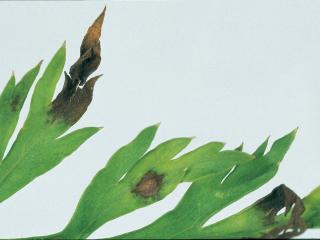
Although symptoms of bacterial blight (Xanthomonas campetris pv. carotae) can be confused easily with those of alternaria leaf blight, the lesions of bacterial blight are smaller, with a characteristic yellow border. However, bacterial blight has only occasionally been observed in Western Australia and not in recent years.
Root scab complex or carrot scab may be caused by seed-borne Alternaria or severe blight outbreaks in the field. This disorder is characterised by thin corky black lesions arising on the secondary root nodes on the carrot. Fusarium species can usually be isolated from scab lesions on carrots taken from the field, but evidence suggests that the Fusarium may be a secondary invader.
Spread
Leaf blight spores are spread by water, wind and machinery. The spores may come from other diseased fields or from debris of decomposing carrot leaves.
Alternaria dauci can be introduced on infested carrot seed. Spores produced on infected plants are spread rapidly during wet windy weather.
Crops that are affected by this disease
Carrot and Parsnip
Necrotic Ring Spot in Turf
Ophiosphaerella korrae
Necrotic ring spot is one of three patch diseases caused by root pathogens that are problems of cool-season turfs. The other two are summer patch of bluegrasses and fine fescues and take-all patch of creeping bentgrass. Though not all caused by the same fungus, these diseases have similar patch-type symptoms, the causal fungi are related and similar in appearance, and these fungi attack grass roots and crowns in a similar manner.

Symptoms
Symptoms of necrotic ring spot appear as circular, ring-shaped, or serpentine patches of dead or dying turf. Affected areas may be a few inches to a foot or more in diameter. These patches may at times coalesce, or they may stand out as individual dead rings. Leaves and stems of affected turf appear yellow or red, then turn a light tan as the disease progresses. Roots and crowns of diseased plants are rotted and recovery of affected areas is slow. Necrotic ring spot seldom occurs in newly planted turf but can occur on turf that has been recently sodded. It may begin during the fourth or fifth year following seeding and can become progressively more severe.
Disease cycle
Ophiosphaerella korrae grows on the surface of grass roots for most of the growing season without causing visible symptoms. When conditions become favorable for the disease, the fungus attacks and destroys the roots. Environmental conditions that favor necrotic ring spot may vary from one location to another. In some locations, the disease is more severe during the cool periods of spring and fall, whereas in other areas, the disease occurs only in midsummer. Necrotic ring spot is generally more severe on drought-stressed turf, but can damage turf growing in moist soils as well.
 lin-chemical.com