Nematode in Nursery seedlings of vegetable crops

Nursery seedlings are infested by various types of nematodes.

These nematodes attack the root system of seedlings in nursery beds. Galling of the roots, stunted growth of roots as well as seedlings are the manifestations of nematode damage in the nursery beds.

Nematodes such as Meloidogyne incognita, M. javanica (root-knot nematodes), Rotylenchulus reniformis (reniform nematode), Heterodera sp., (cyst nematodes) are important among the nematodes attacking seedlings of horticultural crops in nursery beds.

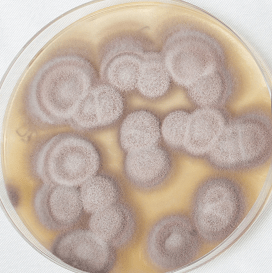
Bio-Nematocide: Paecilomyces lilacinus

Mode of action–Paecilomyces lilacinus

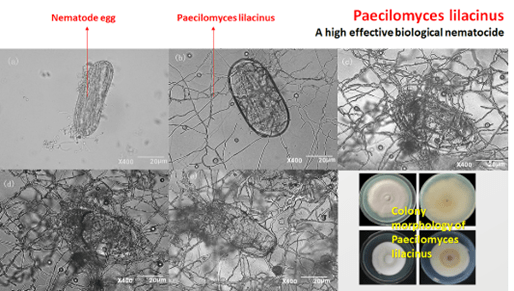
Paecilomyces lilacinus It is mainly egg parasite.

The fungus produces antibiotics viz., leucinostatin and lilacin and enzymes such as protease and chitinase. Protease has nematicidal activity, causes degradation of the eggshell, and inhibits hatching. Chitinase breaks down the eggshell making the route for the fungus to pass through.

The decomposition of chitin releases ammonia, which is toxic to second-stage juveniles of root-knot nematode (RKN).

Its hypha enters the vulva and anus of RKN females. The fungus penetrates the egg and develops profusely inside and over the eggs, completely inhibiting juvenile development. The infected eggs swell and buckle. As penetration continues, the vitelline layer of the egg splits into three bands and a large number of vacuoles; lipid layer disappears at this stage.

The developing juvenile inside the egg is destroyed by the rapidly growing hyphae. Many conidiophores are produced and the hypha moves to the adjacent eggs.

Nematodes in fruit orchards

Nematodes constitute one of the major limiting factors in fruit crop production.

They cause extensive root necrosis resulting in serious economic consequences viz., fertilizers are not effectively utilized, the period from planting to harvesting is extended, drastic reduction in fruit or bunch weights, the quality of fruits is impoverished and fields have to be replanted every 2 to 3 years because of drastic reduction in plant numbers.

Furthermore, roots damaged by nematodes are easy prey to fungi which invade the roots and accelerate root decay.

The root-knot nematode Meloidogyne incognita, the burrowing nematode Radopholus similis and citrus nematode Tylenchulus semipentrans are the major nematode pests that infect these fruit crops.

Biological solution for control nematodes: Paecilomyces lilacinus


A combination of abamectin and Paecilomyces lilacinus

Abamectin has a strong killing effect on nematodes, but cannot kill eggs.

Paecilomyces lilacinus is an endoparasitic fungus and is an important natural enemy of some plant parasitic nematodes. It can parasitize on nematode eggs, and can also infect larvae and females. It can significantly reduce root-knot nematodes, cyst nematodes.

The combination of the two can effectively kill the larvae, adults and eggs of plant nematodes such as stem nematodes, and can also promote the growth of plants, and has a good effect on root protection, repair and rooting.

Paecilomyces lilacinu

Biological applications in controling Fall Amyworm in Maiz 

TestApplications3days after application Average control%7days after application Average control%14days after application Average control %
18billion spore/ml Metarhizium anisopliae OD37.55(±0.73)h51.75(±0.99)e77.27(±0.17)c
23billion PIB/ml Mamestra Brassicae NPV SC84.42(±0.66)c82.91(±0.32)c76.97(±0.27)c
3Compare (60% spinetoram SC)74.45(±0.93)f88.82(±0.58)b69.49(±0.62)e

Tea Saponin-natural extract

Tea Saponin, a glycoside compound extracted from camellia tea seeds, is excellent natural nonionic active surfactant. It can be widely used in pesticide, cultivation, textile, daily chemicals, arthitectural field, medical field and so on.

Tea saponin is triterpenoid saponin, it tastes bitter and spicy. It stimulates mucous membrane of nose to lead to sneeze. The pure product is fine white column-shape crystalloid with strong moisture absorption ability. It presents apparent acidity to methyl red. It’s easy to be dissolved in water, water-contained methanol, water-contained ethanol, glacial acetic acid, acetic anhydride and pyridine etc. Its melting point: 224.

CAS NO.: 8047-15-2

MOLECULAR FORMULATE: C57H90O26