
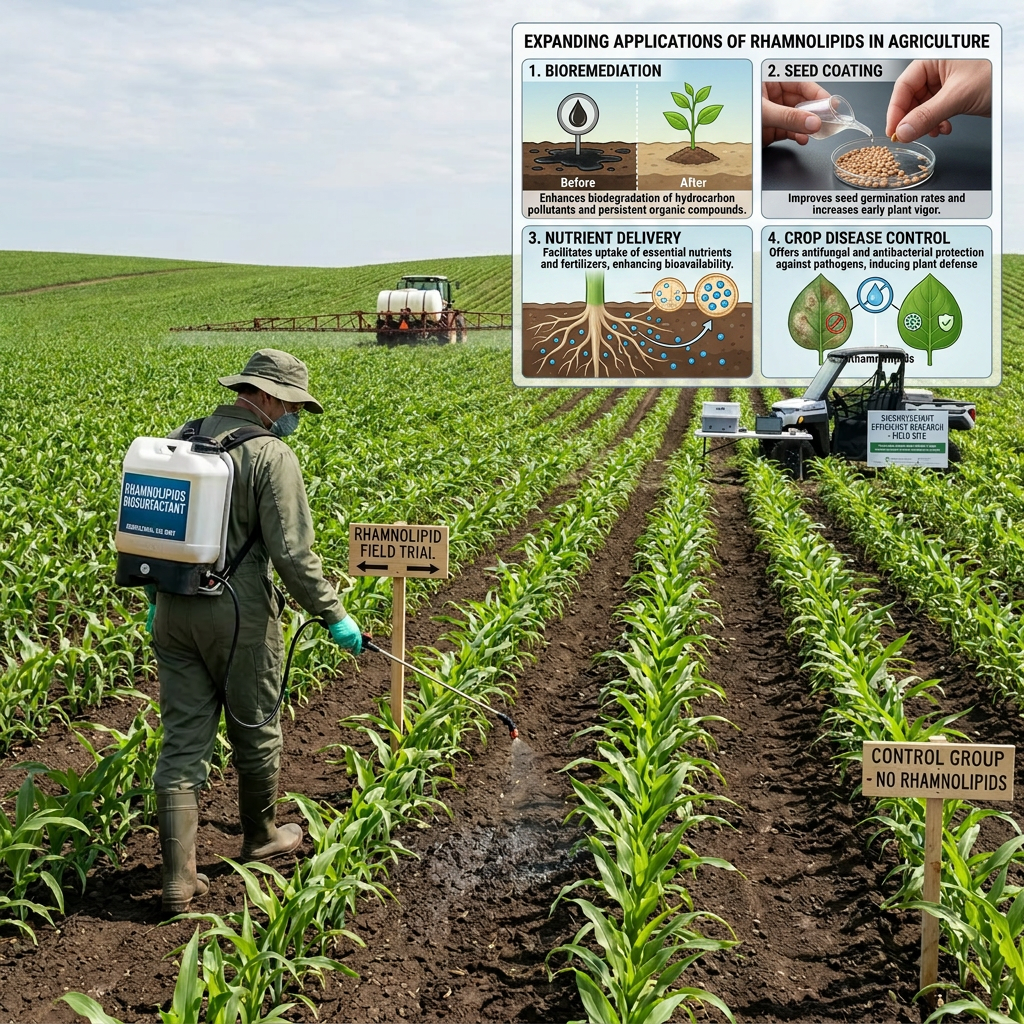
Rhamnolipids (RLs) are considered ideal green and efficient alternatives or enhancers for traditional chemical pesticides and fertilizers in modern agriculture. Their applications are primarily concentrated in four core areas: disease control, fertilizer synergy, plant growth regulation, and soil remediation.
1. Green Biopesticides and Insecticides with Rhamnolipids
Rhamnolipids possess natural antimicrobial activity, showing excellent performance especially against fungal diseases.
- Mechanism: They insert into the phospholipid bilayer of fungal cell membranes, disrupting permeability, which leads to leakage of cellular contents or rapid hydrolysis of spores.
- Target Diseases: Effectively inhibit various fungal diseases such as Phytophthora blight, Pythium damping-off, Botrytis cinerea (gray mold), and Colletotrichum (anthracnose).
- Insecticidal Effect: Studies show that solutions of 20–500 mg/L have significant killing effects on aphids and cockroaches.
- Induced Resistance: They can trigger the plant’s own immune system (e.g., increasing chitinase levels), improving crop resistance to pathogens.
2. Synergistic Adjuvants for Fertilizers and Pesticides with Rhamnolipids
Utilizing their superior surface activity (reducing surface tension to approx. 25 mN/m), rhamnolipids are frequently used as high-efficiency adjuvants.
- Enhancing Efficacy: They lower the interfacial tension on leaf surfaces, allowing the liquid to wet, spread, and penetrate more effectively into plant tissues or pest targets.
- Eco-friendly Substitution: They can replace organic solvents (like xylene) in traditional pesticides, reducing hemotoxicity and pollution to water and soil.
3. Plant Growth Regulation and Biostimulation with Rhamnolipids
- Promoting Root Development: Seeds treated with rhamnolipids (e.g., wheat) can see average root growth increases of about 20%, with more branching and a significant increase in above-ground biomass.
- Assisting Nutrient Uptake: By reducing cell surface tension and modulating root morphology, they help plants absorb soil nutrients more efficiently.
4. Soil Improvement and Environmental Remediation with Rhamnolipids
- Saline-Alkali Land Management: As a soil conditioner, the desalination rate can reach 37.82%, improving soil aggregate structure and increasing microbial diversity.
- Heavy Metal Removal: The carboxyl and hydroxyl groups in their structure can form soluble chelates with heavy metals like Pb, Cd, and As, effectively removing metal pollution through leaching technology.
- Pesticide Residue Degradation: They enhance the solubility of hard-to-degrade organic pesticides (like Lindane) in soil, accelerating microbial degradation of residual pollutants.
 lin-chemical.com