Management for early and late leaf spot in peanut

Fungicides that control early and late leaf spot in peanut

  • chlorothalonil
  • tebuconazole
  • tebuconazole + prothioconazole
  • propiconazole plus chlorothalonil
  • propiconazole plus trifloxystrolin
  • tebuconazole plus trifloxystrobin
  • azoxystrobin
  • pyraclostrobin
  • fluoxastrobin
  • boscalid

Many populations of leaf spot pathogens appear to be insensitive to tebuconazole. Performance of tebuconazole can be improved by mixing it with 12 to 16 oz. chlorothalonil. Tebuconazole can also be mixed with thiophanate methyl.

Scald in barley

AG0765_img_1
Close-up view of scald symptoms


Severe-scald-infection
Severe scald infection

Scald is common disease of barley in temperate regions. It is caused by the fungus Rhynchosporium secalis and can cause significant yield losses in cooler, wet seasons.

Symptoms

Scald is a foliar disease of barley affecting the leaves and sheaths of the plant; however, lesions may also occur on coleoptiles, glumes, floral bracts and awns. Initial symptoms are oval, water-soaked, grayish-green spots, 1.0-1.5 cm long. As the disease develops, the centers of the lesions dry and bleach, becoming light gray, tan, or white with a dark brown margin. The lesions are not delimited by the leaf veins and often coalesce.

Disease cycle

The fungus can infect and survive in barley seed. It exists as mycelium in the pericarp and hull of infected seeds. Infection of the coleoptile occurs as it emerges from the embryo. Optimal infections occur at soil temperatures of 16C. At soil temperatures of 22C or higher, very little infection occurs.

In spring cropping systems, the fungus overwinters on the crop debris and stubble of previous diseased barley crops. The fungus produces abundant conidia on wet lesions during cool, damp weather after the leaf tissue has become necrotic. Conidia, spread by wind and splashing rain, infect young leaves of spring- planted grain. Optimum temperatures for sporulation and infection range from 10-18C. Hot, dry weather reduces the rate of disease development.


Didymella pinodes in pea

Didymella pinodes (syn. Mycosphaerella pinodes) is a hemibiotrophic fungal plant pathogen and the causal agent of ascochyta blight on pea. It is infective on several species such as Lathyrus sativus, Lupinus albus, Medicago spp., Trifolium spp., Vicia sativa, and Vicia articulata, and is thus defined as broadrange pathogen.

D.pinodes symptoms.jpg
Necrotic lesions caused by Didymella pinodes on field pea leaves two weeks after infection.

Symptoms

Symptoms include lesions on leaves, stem and pods of plants. The disease is difficult to distinguish from blight caused by Ascochyta pisi, though D. pinodes is the more aggressive of the two pathogens.

Epidemiology

The disease cycle starts with dissemination of ascospores after which germination pycnidia rapidly develop. Pycnidiaspores quickly disperse by rain splashes are responsible for reinfection over short distances. Consequently, production of pseudothecia is initiated on senescent tissues. After rainfall, ascospores are released from the pseudothecia and disperse by wind over long distances.

Grey leaf spot (GLS) in maize

Grey leaf spot (GLS) is a foliar fungal disease that affects maize, also known as corn. There are two fungal pathogens that cause GLS, which are Cercospora zeae-maydis and Cercospora zeina . Symptoms seen on corn include leaf lesions, discoloration (chlorosis), and foliar blight. The fungus survives in debris of topsoil and infects healthy crop via asexual spores called conidia. Environmental conditions that best suit infection and growth include moist, humid, and warm climates. Poor airflow, low sunlight, overcrowding, improper soil nutrient and irrigation management, and poor soil drainage can all contribute to the propagation of the disease. Management techniques include crop resistance, crop rotation, residue management, use of fungicides, and weed control. The purpose of disease management is to prevent the amount of secondary disease cycles as well as to protect leaf area from damage prior to grain formation. Corn grey leaf spot is an important disease of corn production in the United States, economically significant throughout the Midwest and Mid-Atlantic regions. However, it is also prevalent in Africa, Central America, China, Europe, India, Mexico, the Philippines, northern South America, and Southeast Asia. The teleomorph (sexual phase) of Cercospora Zeae-Maydis is assumed to be Mycosphaerella sp.

Host and Symptoms

Corn is the only species that can be affected by Cercospora zeae-maydis. There are two populations of Cercospora zeae-maydis, distinguished by molecular analysis, growth rate, geographic distribution, and cercosporin toxin production. Cercospora Zeae-Maydis differs from its cousin group Cercospera zeina sp. nov in that it has faster growth rate in artificial media, the ability to produce the toxin cercosporin, longer conidiophores, and broadly fusiform conidia. Cercospera zeina sp. nov affects corn in the Eastern Corn Belt and Mid-Atlantic States; Cercospora Zeae-Maydis is found in most corn producing areas of western Kentucky, Illinois, Indiana, Iowa, Wisconsin, Missouri, Ohio, and west Tennessee (Midwest). Both populations share the same symptoms and virulence, the ability of the fungus to invade the host.

Major outbreaks of grey leaf spot occur whenever favorable weather conditions are present (see Environment section). The initial symptoms of grey leaf spot emerge as small, dark, moist spots that are encircled by a thin, yellow radiance (lesions forming). The tissue within the “spot” begins to die as spot size increases into longer, narrower leaf lesions. Although initially brownish and yellow, the characteristic grey color that follows is due to the production of grey fungal spores (conidia) on the lesion surface. These symptoms that are similar in shape, size and discoloration, are also prevalent on the corn husks and leaf sheaths. Leaf sheath lesions are not surrounded by a yellow radiance, rather a brown or dark purple radiance. This dark brown or purple discoloration on leaf sheaths is also characteristic to northern corn leaf blight (Exserohilum turcicum), southern corn leaf blight (Bipolaris maydis), or northern corn leaf spot (Bipolaris zeicola). Corn grey leaf spot mature lesions are easily diagnosed and distinguishable from these other diseases. Mature corn grey leaf spot lesions have brown rectangular and vein limited shape. Secondary and tertiary leaf veins limit the width of the lesion and sometimes individual lesions can combine to blight entire leaves.

Pathogenesis

One reason for the pathogenic success of Cercospora zeae-maydis is the production of a plant toxin called cercosporin. All members of the Cercospora genus produce this light-activated toxin during infection. In the absence of light, cercosporin is inactive, but when light is present, the toxin is converted into its excited triplet state. Activated cercosporin reacts with oxygen molecules, generating active single oxygen radicals. Oxygen radicals react with plant cell lipids, proteins, and nucleic acids, damaging and killing affected cells, and nutrients released during the cell rupture and death feed the Cercospora fungus. A study of mutant Cercospora lacking the gene responsible for cercosporin production demonstrates that, though unnecessary for infection, cercosporin increases the virulence of Cercospora fungi.

Disease Cycle

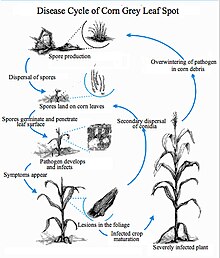
Cercospora zeae-maydis survives only as long as infected corn debris is present; however, it is a poor soil competitor. The debris on the soil surface is a cause for primary inoculation that infects the incoming corn crop for the next season. By late spring, conidia (asexual spores) are produced by Cercospora zeae-maydis in the debris through wind dispersal or rain. The conidia are disseminated and eventually infect new corn crop. In order for the pathogen to actually infect the host, high relative humidity and moisture (dew) on the leaves are necessary for inoculation. Primary inoculation occurs on lower regions of younger leaves, where conidia germinate across leaf surfaces and penetrate through stomata via a flattened hyphal organ, an appressorium. Cercospora zeae-maydis is atypical in that its conidia can grow and survive for days before penetration, unlike most spores that need to penetrate within hours to ensure survival. Once infection occurs, the conidia are produced in these lower leaf regions. Assuming favorable weather conditions (see Environment Section), these conidia serve as secondary inoculum for upper leaf regions, as well as husks and sheaths (where it can also overwinter and produce conidia the following season). Additionally, wind and heavy rains tend to disperse the conidia during many secondary cycles to other parts of the field causing more secondary cycles of infection. If conditions are unfavorable for inoculation, the pathogen undergoes a state of dormancy during the winter season and reactivates when conditions favorable to inoculation return (moist, humid) the following season. The fungus overwinters as stromata (mixture of plant tissues and fungal mycelium) in leaf debris, which give rise to conidia causing primary inoculations the following spring and summer.

Early leaf spot in peanut

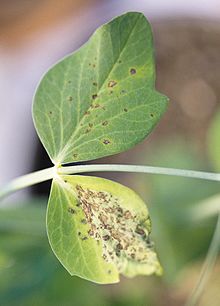
Cercospora arachidicola is a fungal ascomycete plant pathogen that causes early leaf spot of peanut.

Peanuts (Arachis hypogaea) originated in South America and are cultivated globally in warm, temperate and tropical regions.

All cultivars of peanuts are equally susceptible to peanut fungal pathogens; however, C. arachidicola is an economically important peanut pathogen and is responsible for significant economic losses in the peanut industry, more specifically in the Southeastern, Eastern, and the Southwestern United States.

Early leaf spot of peanut can drastically reduce yields, leading to economic downturn of the peanut crop economy.

Annual crop losses in the United States range anywhere from less than 1% to greater than 50% depending on disease management and treatment.

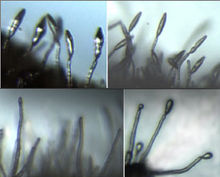
early leaf spot – close-up of conidia (seen as silvery, hair-like areas on the spot)
Cercospora arachidicola (early leaf spot pathogen)


QoI: quinone outside inhibitors

Qo inhibitors (QoI), or quinone outside inhibitors, are a group of fungicides used in agriculture. They represent the most important development made in fungicides by the chemicals industry. QoI are chemical compounds which act at the quinol outer binding site of the cytochrome bc1 complex.

QoI’s are the resulting fusion of three fungicides families, the well-known family of strobilurins and two new families, represented by fenamidone and famoxadone. Some strobilurins are azoxystrobin, kresoxim-methyl, picoxystrobin, pyraclostrobin, and trifloxystrobin.

These fungicides are used on a wide range of crops, such as cereals, vines, pome fruits, cucurbits, tomatoes and potatoes.

For example, they are used as fungicides for cereals, against Erysiphe graminis f.sp tritici responsible for the powdery mildew in wheat or against Septoria tritici, responsible for septoria leaf spot in wheat.

They are also commonly used for vine culture, against Plasmopara viticola, responsible for downy mildew or in oïdium treatment.

Note: All these fungicides are in the same cross-resistance group (same mode of action) and must be managed carefully to avoid the appearance of fungicide resistance. Some fungicide resistance has been observed in most crops (such as in the case of wheat powdery mildew), so the application of QoI products should respect effective rates and intervals to provides time and space when the pathogen population is not influenced by the product selection pressure.

Disease Management on cherry leaf spot

Low power image of sporulating acervuli on the underside of a tart cherry leaf;
Close up of the formation of an acervulus on the underside of a tart cherry leaf.

Resistance

There are no resistant varieties available on the commercial market yet. However, researchers have found the a wild type gene linked to the resistance. They are currently crossbreeding the wild lines with commercial cultivars and beginning to carry out field trials. No data is available yet.

Small or backyard growers

For small or backyard growers, collecting and destroying all leaf debris on the ground is an absolute necessity due to the potency of this disease because the fungus overwinters in this leftover leaf litter. This is its main form of survival. By removing and destroying these leaves, a grower can significantly decrease the amount of primary inoculum available in the spring. It will greatly decrease the apparent infection rate. There has also been a study done on the addition of a straw mulch bedding to the ground after all the leaves have been picked up. The addition of this mulch further reduced the spring infection rate. Leaf litter removal is not very practical for large commercial growers due labor needs and number of trees but if at all possible, a majority of the old leaves should try to be collected.

When planting, growers should select locations which have a large amount of direct sunlight such as a south facing slope. Proper pruning should also be completed to increase the amount of sunlight penetration and air circulation through the canopy. Any practice that increases the faster drying of leaves will help reduce the risk of infection. Growers may also consider making an after harvest fungicide application using a combination of Benomyl (50% WP)and Captan (50% WP) at rates of 1/4 Tablespoon and 2 Tablespoons respectively per gallon of water. This will help reduce the rate at which pathogens may develop resistance to Benomyl products. Prior to shuck split, the recommended fungicide for cherry leaf spot is chlorothalonil (Bravo and generics).This fungicide is a multi-site protectant and is excellent for leaf spot control and is not at risk for fungicide resistance development. At least two applications of chlorothalonil should be made before shuck split with the goal to minimize the potential of infection at this early stage.

Commercial growers

For commercial growers, the disease is primarily controlled by use of fungicide sprays. Fungicides are much more effective when applied early in the season when the inoculum load is low as cherry leaf spot is a prolific, unrelenting, tireless disease.

Fungicide applications should begin at petal fall or shortly after leaves have unfolded. These sprays should continue on a schedule of every 7–10 days until harvest. Upon harvest, one or two postharvest applications should be administered, beginning 2–3 weeks after harvest. It is suggested that spraying alternate sides of trees on a 7-day program is more effective than spraying both sides of trees on a 10-day schedule.

Michigan State University suggests getting an early start on protection before the fungus starts infecting for the production year. This means that growers should spray the at the bract leaf stage with chlorothalonil (Bravo and generics). These bract leaves open prior to bloom, which means bract leaves could be infected early, before petal fall. Typically the first fungicide application is recommended around petal fall, but due to the early and epidemic levels of infection in found in 2012, the first application should be applied earlier.

Significant infection was also found in the bract leaves in mid- to late June 2012. This was particularly surprising because the weather conditions were not notably conductive to the super development of cherry leaf spot infection. These early and significantly strong infection rates indicate that the fungus is evolving and becoming resistant to certain fungicide treatments. Control programs will need to be altered to keep up with the genetic advancement of the fungus. These earlier infections are a concern because once infection occurs; more spores will be produced from the lesions (conidia) than the leaf debris (ascospores) on the ground. These conidia are much more potent than ascospores in terms of infection rate.

In addition, spores from the lesions are much closer to new uninfected leaves than the spores from the leaf debris on the ground. Due to the smaller distance, infection will occur much quicker. Dr. George Sundin, a professor and fruit extension specialist from Michigan State University advocates that the new chemistries of succinate dehydrogenase inhibitors (SDHIs) are also effective in controlling cherry leaf spot. Pristine was registered in 2004. It is a premix of boscalid (SDHI) and pyraclostrobin (strobilurin). This has been indicated effective at a rate of 10.5 oz/acre. Other SDHIs that may be effective in cherry leaf spot control include fluopyram (a pyramide manufactured by Bayer AG under the name “Luna”) and fluxapyroxad (a pyrazole-carboxamide manufactured by BASF SE under the name Merivon).

Sterol demethylation inhibitor (DMI) fungicides including fenarimol, fenbuconazole, myclobutanil, and tebuconazole were used immensely in the 1980s and 1990s. The efficacy of DMI fungicides has decreased dramatically in recent years and have not been used greatly since 2002.

In an effort to keep a high level of diversity in the cherry fungicide programs and reduce the amount of resistance building up to the DMI fungicides, copper based fungicides can be used with great efficacy to battle the fungus. However, the copper application is associated with noticeable leaf bronzing. There has been great concern that this bronzing causes a highly negative effect on the photosynthetic integrity of the leaves which in turn decreases the number of fruits per shoot, fresh fruit weight, and soluble solids concentration of the mature fruit. It has been scientifically proven that the standard application of copper based fungicides does not have any adverse effects on the developing fruit.

Cherry leaf spot

Cherry Leaf Spot 2.jpg
Lesions on diseased leaves

Photograph by Prof. Glen R. Stanosz Dept. of Forest and Wildlife Ecology University of Wisconsin-Madison

Cherry leaf spot is a fungal disease which infects cherries and plums.

Sweet and sour cherries are susceptible to the disease; however leaf spot is much more prevalent in sour cherries.

The variety of sour cherries that is the most susceptible are the English Morello cherries.

This is considered a serious disease in the Midwest, New England states, and Canada.

It has also been estimated to infect 80 percent of orchards in the Eastern states. It must be controlled yearly to avoid a significant loss of the crop.

If not controlled properly, the disease can dramatically reduce yields by nearly 100 percent.

The disease is also known as “yellow leaf” or “shothole disease” to cherry growers due to the characteristic yellowing leaves and shot holes present in the leaves upon severe infection.

Fungal pesticides offer a growing alternative to traditional chemicals

Pesticides based on fungi are just one example of biopesticides, a group that also includes bacteria and biochemicals derived from plants.

Biopesticides are a tiny segment of the market for now – but their use is projected to grow at a faster rate than traditional synthetic pesticides over the next few years.

When it comes to biopesticides, one of the most widely used fungi is Beauveria bassiana. Above, a kudzu bug killed byBeauveria bassiana, seen growing out of the cadaver.
Courtesy of Brian Lovett/University of Maryland Entomology

The growth of the organic produce industry is one factor giving biopesticides a boost. So, too, are regulatory hurdles, says Sara Olson, a senior analyst at Lux Research.
“As it gets harder to get approval for novel synthetics and existing synthetic pesticides are pulled from shelves, biopesticides become more attractive,” Olson says.
And then there’s the rise of weeds and microbes resistant to traditional pesticides. “Many commonly used chemical pesticides are facing pressure today due to overuse, improper use, and long-term use,” she says.
Some biopesticides repel pests, while others disrupt mating or cause a specific disease to strike invaders that would nibble on delicate fruits and vegetables.
Fungal-based biopesticides take things up a notch. Many of these products contain parasitic fungi – the kind that grow inside an insect’s body and feed on its internal tissue until it dies (and sometimes beyond that).
While this might sound horrific, for some the benefits of using fungal-based biopesticides, rather than traditional chemicals, may outweigh the brutality.
Nemat Keyhani, a professor at the University of Florida Institute of Food and Agricultural Sciences, says fungus is compatible with organic farming, harmless to vertebrates — like humans, birds, dogs and cattle — and has a low environmental impact.
That’s especially true when compared with synthetic pesticides, which often contain toxic chemicals such as arsenic, chlorine, ammonia and formaldehyde. Some synthetic pesticides have been shown to have harmful effects on the environment and human health. One family of pesticides, called neonicotinoids, is being blamed for the decline in bee populations over the last decade.
Fungi, on the other hand, are alive, and they could evolve along with the insects that they’re being used to control. That means pesticide resistance may become less of an issue, says Olson.
Metarhizium anisopliae, a rice shell pest.
Courtesy of Dr. Yuxian Xia and Nemat O. Keyhani, Chongqing University
“It’s a complex interaction between the fungus and the pest you’re trying to control, rather than a direct, single-chemistry interaction from the synthetics, so that’s going to make them potentially more robust to a resistance developing,” Olson explains.
There are approximately 1,000 known species of entomopathogenic fungi – the kind that kill or seriously disable insects. Collectively they target most, if not all, agricultural pests, says Raymond St. Leger, an entomologist at the University of Maryland.
When it comes to biopesticides, one of the most widely used fungi is Beauveria bassiana. It infects a range of insects and is commercially formulated as products including Naturalis L, Naturalis H&G, Mycotrol and BotaniGard.
“In the 1800s, this was one of the very first fungi recognized as a disease agent that killed insects,” says St. Leger.
It causes a disease known as the white muscardine. Even after an insect is killed, the downy mold continues to produce millions of new infective spores that are released into the environment. Beauveria bassiana effectively targets the pecan weevil, Colorado potato beetle and kudzu bug, among other pests.
Trichoderma, a versatile mold, is also commonly used. Some release enzymes that dissolve potential pathogens; others form barriers around plant roots and make it impossible for harmful bacteria and pathogens to pass through.
Another fungus — Metarhizium, or the green muscardine fungus — is frequently used in the field, shielding crops from beetle grubs, wireworm, corn root worms and countless other insects. One variant is now being used to develop biopesticides — including a line by MycoPesticide — that can cause a mushroom to grow from a pest’s dead body to distribute spores that warn other insects.
But biopesticides can be quite expensive compared to synthetic pesticides. They often don’t work as quickly and they have to be applied more frequently, making them a tough sell in some markets.
Paul Underhill, co-owner of Terra Firma Farm, an organic grower in Winters, Calif., has tried a few. “Some, like those with fungi, can require special storage, such as refrigeration. [And] the cost to the farmer can easily be 20 times what a conventional pesticide might be,” he says.
One more downside: Biopesticides can be more sensitive to environmental conditions, including relative humidity and temperature and exposure to UV radiation.
Genetic manipulation might be the next step to get more fungi-based products to the market. Scientists are working with transgenic strains to improve fungi’s ability to kill insects, tolerate adverse conditions and, extending beyond crops, fight against the transmission of diseases such as West Nile virus, Lyme disease and malaria. St. Leger’s team is currently testing a strain of Metarhizium that’s had a spider gene inserted that selectively targets mosquitoes.